OSU is situated in one of the fastest-growing urban centers in the nation, with a unique and explicit mission as a land-grant institution grounded in teaching, service, and research. We propose an extension research initiative, the Heat Exchange, to build cooperative, climate-resilient communities across Ohio using closed-loop geothermal technology, testing its efficacy, scalability, economic viability, and programmability. Geothermal technology has the potential to dismantle the current extractive and exploitative energy systems that define our infrastructure, sanctioning 24/7 energy independence for Ohioans while significantly reducing the environmental externalities of energy production. The Heat Exchange will exist as a series of geothermal research hubs placed at the doorsteps of Ohio’s communities, where energy infrastructure is daylighted, fully programmed, and in direct service to the people it grounds.
We are initially proposing the deployment of three geothermal wells, one on OSU's campus, one in the Mount Vernon neighborhood, and one within an agricultural community in Clifton, Ohio.mOSU already has two geothermal systems on campus that employ a traditional matrix of several hundred shallow wells (about 600 feet deep). One at the 4H Center on West Campus, and one on the south oval that has the capacity to heat and cool all south campus buildings.
But as demand for electricity in central Ohio is expected to more than double by 2028 (going from 4,400 megawatts to over 10,000) OSU needs to question how we meet the needs of the new energy market. Furthermore, as we hopefully begin rapidly phasing out fossil fuels, supply is leaving the grid at a faster rate than it’s being replaced. As part of our land grant mandate, OSU should respond to the demand issues stemming from a major influx of data centers, state restrictions on renewable energy, and the fact that Ohioans depend on imported energy for over 15% of their power. Traditional geothermal can get us only so far, but new techniques that employ conventional drilling mechanisms from the oil and gas industry offer access to extremely high temperatures 2 miles down. Our project is modeled on Cornell’s Earth Source Heat Project in Ithica, and the EAVOR-Loop in Alberta, Canada. Our hybrid of Advanced Geothermal Systems takes advantage of basement rock temperatures without the need for major seismic activity or fracking. Two 3-foot-diameter cores are drilled deep into the earth and connect through a series of closed horizontal pipes. As cold degraded water is pumped down one well, radiant heat exchanges from the basement rock to the flowing water. The water vapor (now up to 350*C) is pumped to the surface through the second well. That water cycles back down after going through a heat exchanger that connects to another closed-loop bound either for turbines that convert the heat to electricity, or directly to a system of direct heating and cooling. This system allows a smaller footprint and significantly higher temperatures, which generate way more megawatts per acre than traditional geothermal. The systems we’re deploying in these iterations can produce 3 megawatts, which has the capacity to power more than 2000 homes.
One of our goals with the Neighborhood Exchange was to consider how geothermal infrastructure might be deployed into existing urban conditions. Daylighting the power grid, and furthering what research and extension can look like. We chose the Mt Vernon neighborhood on the near east side of Columbus both for its size, about 2600 homes, and because of Ohio State’s large (and potentially expanding) presence there. The project begins at Saunder’s Park where our geothermal system integrates into the daily life of Mt Vernon residents. Saunder’s Park is home to the culturally significant Maryland Pool, soccer leagues, walking/running paths, and the adjacent OSU Outpatient East Hospital. The production wells are built into a cut area of a constructed berm instead of a conventional flat pad. This creates a landform that functions as terraced garden plots. From time to time, filtered steam from the system is allowed to escape to prolong the growing season. The heat is exchanged to another closed loop that travels in an above ground pipe to the energy transfer zone. Here electricity is produced through a system of turbines and condensed water cycles back through the system. Some “loss” of efficiency is permitted as steam escapes into a glass pavilion. This humidity-controlled environment becomes an indoor garden conservatory and program space. The loss of efficiency is actually seen as a gain in community engagement. Electricity then travels underground to three mini-substations. One at Maryland Pool, one at Sawyer Park, and one at Dreamfield Park. Replacing one conventional 3-4 acre substation with these smaller nodes in public spaces creates beacons of power in the community. From here, electricity is then delivered to the homes. Walking paths through groves and prairies provide access to the site and connect the Neighborhood Exchange back to OSU East Hospital. The Neighborhood Exchange proposes to push the boundaries of extension by bridging the gaps that exist among food systems, climate change, community development, and energy research.
The Campus Exchange examines the expansion of Ohio State’s geothermal energy, currently isolated to South campus dorms, 411 geothermal wells providing less than 1% of Ohio State's current energy demand, by converting OSU’s natural gas power plant to an advanced geothermal closed-loop system, anticipated to produce 65 MW, energy currently being purchased from the retail electric service provider market, at a significant environmental cost. This proposal counterpoints the current construction of a combined heat and power plant on the west campus supplied by hydraulic fracking of natural gas. In addition to energy production, the Campus Exchange introduces a secondary programmatic layer to a site typology typically sealed from public access. Today, most power plants are secured behind fencing and barricades, rendering energy production invisible despite its centrality to campus infrastructure. This proposal exposes the geothermal loop, its production logic, thermal exchange process, and distribution network, making the system legible to the students, faculty, and researchers who depend on and inhabit it. With closed-loop geothermal remaining a relatively nascent technology in the United States, daylighting the system presents a significant opportunity for public education and institutional research. The exposed geothermal infrastructure is organized around two primary site experiences: a hot springs environment and a series of climate-controlled ecologies. Beyond power generation, the system conditions the ground plane to support plant communities otherwise unavailable to Ohio's climate during the winter months. A living roof encompasses the geothermal distribution lines, which thermally charge soil beds to accelerate bloom cycles and extend growing seasons. This climate-controlled ecology enables year-round botanical and environmental research on campus. As global temperature and precipitation patterns shift, the site functions as a forward-looking design laboratory, trialing species compositions calibrated to anticipated future climate conditions in the region.
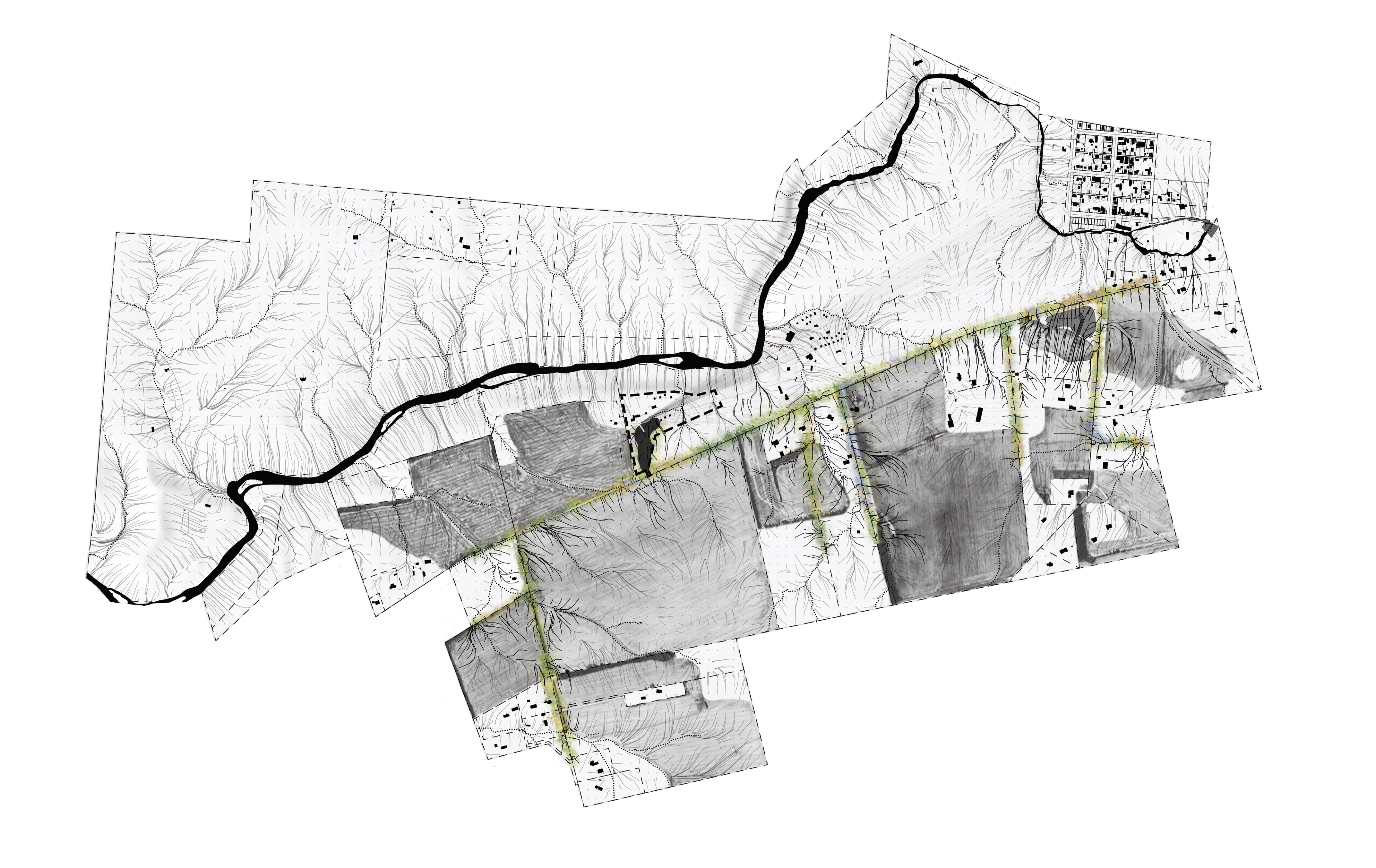
The Wetland Exchange proposes the integration of a geothermally regulated wetland mesocosm sited at the intersection of extensive agricultural land use and a nationally designated Scenic River, a location where the consequences of nonpoint source pollution are both measurable and ecologically urgent. Existing tile drainage systems carrying agricultural runoff will be intercepted and connected to a network of bioswales, which convey and filter that water into the mesocosm before it is stored as a reservoir for irrigation reuse, closing the agricultural water cycle on site. The design logic was initiated by the existing topography and analysis of the extant hydrological system. Overlaying zoning, intersections with the area's drainage profile were mapped as intervention points to intercept runoff, and loop into a system of channels that have been graded with a 1% cross slope and a minimum 0.5% longitudinal slope, to redirect water towards the wetland. The bioswale network is designed as a three-tier experimental planting system thermally optimized by a network of geothermal conduits that seasonally adjusts the temperature of the substrate. The geothermal well buried within the site is the experimental instrument that distinguishes this mesocosm from conventional constructed wetlands. By thermally regulating water temperature across each planting tier, the system generates three simultaneous experimental conditions within a single landscape, allowing direct comparison of nutrient removal performance, plant survival, and biomass production across thermal regimes. The literature suggests that thermoregulation could yield meaningful increases in both nitrogen and phosphorus removal over ambient baseline performance. The most significant gains occurring in autumn and winter, the seasons when conventional wetlands enter biological dormancy, but when agricultural runoff pressure remains highest. This is not simply a water quality project. It is a proposal for a new kind of research landscape, one that is productive, experimental, and deeply entangled with the agricultural and ecological systems that surround it. A landscape that generates knowledge, cleans water, grows food, heats homes, and asks what an Ohio wetland might become under the pressures of a changing climate.
These iterations just scratch the surface of what’s possible. We see it as a start. As a way that Ohio State can reframe Extension for the 21st century, develop new ways of research and community development, and directly respond to the increasing energy needs of Ohioans.